
The Design Document: Making Learning Intentional Before Learning Begins
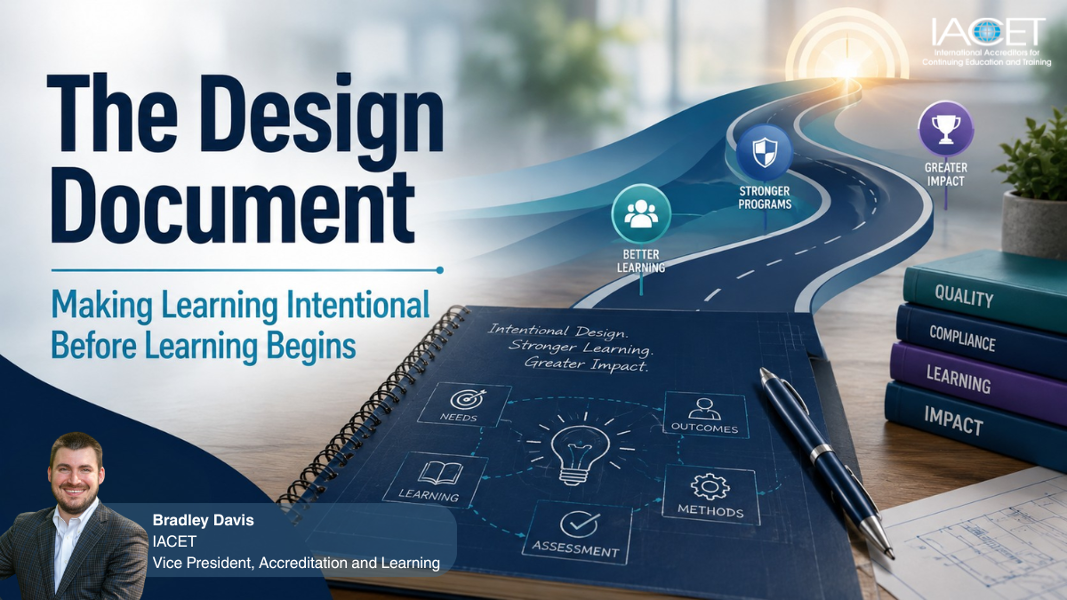
When people hear the term "design document," they often imagine a compliance artifact: a worksheet, a template, or something completed because an accreditor, auditor, or reviewer asked for it. That's unfortunate, because a strong design document is something much more valuable than a checkbox.
It is one of the earliest indicators of whether a learning experience has been designed intentionally or assembled reactively. Long before a learner logs into an LMS, joins a webinar, or walks into a classroom, the design document serves as the bridge between a learning need and a learning solution. It captures the decisions that transform good intentions into meaningful educational experiences and, perhaps more importantly, answers a question every learning professional should be asking: why is this learning event structured this way?
That might sound simple, but the answer reveals a great deal about the quality of a learning program.
Making Learning Decisions Visible
One of the greatest strengths of a design document is that it makes instructional decisions visible. It creates a clear record of what learners should be able to do after the learning experience, how the content is organized to support those outcomes, why instructional time is allocated as it is, and how learner achievement will be measured.
Without that visibility, learning programs often rely on institutional memory, individual instructor expertise, or assumptions about what has worked in the past. Those factors certainly have value, but when they become the primary drivers of a learning experience, consistency becomes difficult to maintain. Quality that lives in a person rather than in a system is quality that doesn't survive turnover; a design document creates a shared understanding of intent that helps ensure learning remains aligned with its objectives regardless of who facilitates the course or how it is delivered.
Why Design Documents Matter for Accreditation
From an accreditation perspective, design documents occupy an interesting position because they connect multiple aspects of the learning process at once. A single design document can demonstrate that learning outcomes were intentionally developed, that instructional methods support those outcomes, that assessments measure what learners are expected to achieve, and that time allocations are grounded in instructional purpose rather than estimation.
In many ways, design documents sit at the intersection of policy, process, and evidence. Rather than treating learning outcomes, instructional methods, and assessments as isolated components, the design document shows how they work together as a cohesive system. This alignment is particularly important when organizations are awarding continuing education units (CEUs), where instructional time and learner achievement must be supported by thoughtful design rather than assumptions.
What Does a Strong Design Document Include?
There is no single required format for a design document; some organizations use highly structured templates, while others rely on proprietary instructional design models or internal development tools. The format matters far less than the information being communicated. At a minimum, a strong design document generally includes five components:
- Needs analysis: Why does this learning event exist? A needs analysis identifies the gap, challenge, opportunity, or business need that the learning experience is intended to address. Without it, you're building a solution without confirming the problem.
- Learning outcomes: What should learners be able to do as a result of participating? Strong outcomes use measurable and observable language that focuses on learner performance rather than content coverage. If your outcomes describe what the instructor will teach rather than what the learner will demonstrate, that's a signal worth paying attention to.
- Learning structure: How is the learning organized? This typically includes modules, sections, activities, and time allocations that demonstrate how learners will progress toward the intended outcomes. The structure should tell a story about the learning journey, not just list topics in sequence.
- Instructional methods and resources: How will learning occur? This section outlines instructional approaches, learning activities, technologies, and supporting materials used throughout the experience. It's where design decisions become operational.
- Assessment strategy: How will learner achievement be evaluated? Effective assessment methods align directly with the outcomes they are intended to measure and, when appropriate, include minimum performance expectations. If your outcomes say one thing and your assessments measure another, the design document is where that misalignment becomes visible.
Together, these five elements tell a cohesive story about the learning experience and the decisions that shaped it.
Supporting Consistency Across Delivery Methods
One benefit of design documents that deserves more attention than it typically receives is consistency. As organizations grow, courses evolve; new facilitators are onboarded, delivery methods expand, and what once existed solely in a classroom may now be delivered synchronously online, asynchronously through an LMS, or through a blended model. Without a documented design framework, those transitions can introduce unintended variation.
A design document helps maintain alignment across delivery methods by preserving the original instructional intent. It creates a reference point that allows organizations to adapt learning experiences while maintaining consistency in outcomes, assessment, and learner expectations. And for any organization scaling across formats or onboarding new facilitators regularly, that distinction matters more than most people realize.
A Note About Timing
A common misconception is that design documents must be created years before a learning event is delivered. Let's be honest: that isn't the case. What matters is that the design document accurately reflects how the learning experience was designed and implemented.
As with many aspects of quality assurance, the goal isn't perfection; it's alignment. Organizations should focus on ensuring that documentation accurately represents practice and that instructional decisions can be clearly explained and supported. If someone asks, "Why is this session structured this way?" and the answer is, "Because that's how we've always done it," the design document has surfaced something valuable, even if the answer is uncomfortable.
From Evidence to Asset
Organizations sometimes view design documents as something they create for accreditation, but the most successful organizations tend to view them differently. They use design documents to onboard instructors and facilitators, support course revisions and updates, evaluate learning effectiveness, preserve institutional knowledge, and maintain consistency as programs scale.
In other words, the design document becomes an operational asset, not simply evidence for a review process. Accreditation may encourage organizations to formalize their design practices, but the long-term value extends far beyond accreditation itself. The organizations that treat design documentation as an ongoing practice rather than a periodic exercise are the ones that build learning programs capable of improving over time.
A Final Thought
A design document is not a script. It isn't intended to limit creativity, constrain facilitators, or dictate every moment of a learning experience. Instead, it serves as a record of intentionality; it captures the thinking that occurs before learning begins and creates a visible connection between need, design, delivery, and outcomes.
When done well, design documents do more than support accreditation requirements. They help organizations build learning experiences that are consistent, defensible, and ultimately more effective for the people they serve. And perhaps that is the most important role a design document can play: not documenting learning after the fact but ensuring that quality is built into the learning experience from the very beginning.
About the Author

Bradley A. Davis, CAE, BRMP, is the Vice President of Learning Strategy for the International Accreditors for Continuing Education and Training. His leadership philosophy — emphasizing equitably meeting subject matter experts, contractors, staff, clients, members, volunteers, and prospective personas where they are, whenever they are — has ensured strong connections across his various work environments, promoting life-long value throughout constituents’ tenure. Bradley graduated from Southeastern Louisiana University with a B.A. in History, in addition to earning both a Master of Military History and a Certificate in Teaching and Learning from Norwich University. A 2024 Forty Under 40, 2024 – 2026 ASAE Diversity in Executive Leadership Scholar, and 2026 Emerging Training Leader of the Year, he has earned the Business Relationship Management Professional credential from the BRM Institute as well as the Certified Associate Executive credential from ASAE.