Passport to Success: The IACET Self Assessment Checklist and the Annual Report
When IACET-accredited providers hear “annual report,” most think first of membership dues and a renewal date. The Self-Assessment Checklist that accompanies it usually gets less attention, treated as a formality attached to the paperwork. This is missed opportunity, because the checklist is the mechanism the Standard actually relies on to keep organizations honest about their own compliance between accreditation cycles.
Under the ANSI/IACET 1-2018 Standard, Element 1.5 requires a periodic internal review process that covers the entire Continuing Education/Training (CE/T) program. 1.3 b requires a job description that fully details tasks and responsibilities associated with conducting the periodic review. The Self-Assessment Checklist is the tool most providers use to satisfy both requirements at once. Used well, it functions less like a form and more like a passport: a document checked and stamped at intervals throughout the accreditation journey, showing where an organization is in good standing and where work is still in progress.
What the Standard Actually Asks For
The instructions accompanying the checklist specify what a periodic review must accomplish. It confirms that policies and processes required by the Standard are current and accurate. It verifies that those policies have been communicated, since having a policy in place isn't sufficient on its own; there must be evidence it reached the people who need to follow it. It maintains documentation of actual activities and practices, not blank templates, because a formal review requires completed forms, worksheets, or reports as proof the process is being followed rather than simply written down.
That three-part test—current and accurate, clearly communicated, and evidenced in practice—is what separates a real periodic review from a paperwork exercise.
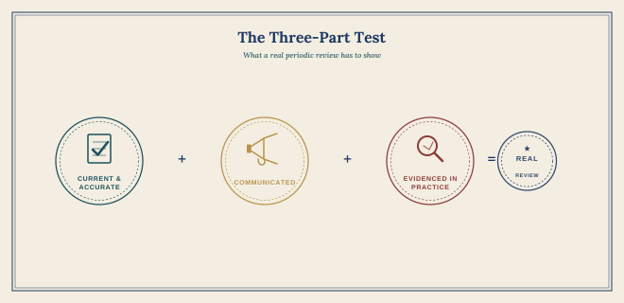
The three-part test for a genuine periodic review.
Walking Through the Checklist
The checklist is organized into nine categories that mirror the full structure of the Standard: Organization, Responsibility and Control; Learning Environment and Support Systems; Planning; Needs Analysis; Learning Outcomes; Content and Instruction; Assessment of Learning Outcomes; Awarding the IACET CEU and Maintaining Learner Records; and Evaluation of Learning Events.
Within each category, every element of the Standard is paired with the required evidence a reviewer would expect to see, a straightforward determination of whether the requirement is fully met, and, where it isn't, a space to explain what corrective action is planned. Each category closes with a line identifying who completed that section of the review and by when outstanding items will be addressed. The full document ends with a single signature and date from the person responsible for overall compliance.
That structure matters for two reasons. It forces a provider to work through the entire Standard rather than the sections that come up in conversation, and it creates a paper trail showing not just that a gap existed, but who found it and what was done about it.
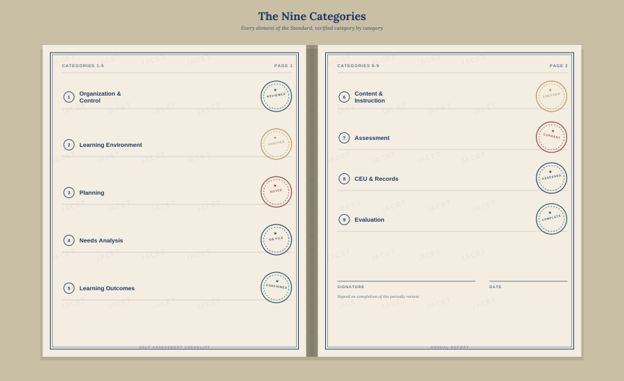
The nine categories of the Standard, self-assessment checklist style.
What Counts as a Finding
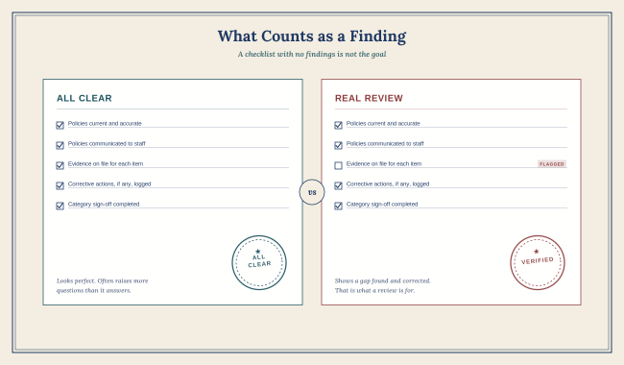
A checklist with no findings is not the goal.
A common misconception is that a strong self-assessment is one with no findings at all, with every box checked “yes,” and nothing flagged for follow-up. In practice, the opposite tends to be true. Organizations drift from strict compliance over time in small, ordinary ways, and IACET does not penalize a provider for discovering that during a self-audit.
Reviewers are looking for evidence that an organization can recognize where it has drifted and shows the steps taken to correct it. A checklist that comes back entirely clean, year after year, often raises more questions than one that documents real findings and real remedies.
From Compliance Task to Organizational Asset
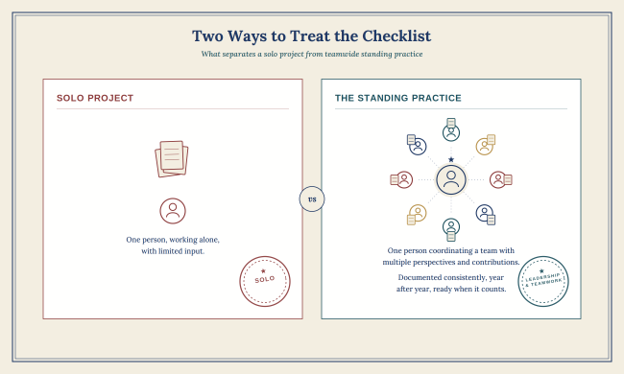
Providers who treat the checklist as an annual chore often experience it that way: a rushed exercise completed close to the anniversary date, with limited input from the people who actually do the work being reviewed. Providers who treat the process as a standing practice get more out of it. Because each category has its own sign-off line, the checklist is built to be completed by the people closest to that part of the program rather than by one person working alone, which typically produces more accurate evidence and a clearer picture of where the organization actually stands.
There's also a practical payoff at reaccreditation. Part of that application asks what improvements an organization has made since its last review. Providers who have consistently completed the checklist already have that answer documented, category by category, rather than needing to reconstruct several years of history from memory in the weeks before a deadline.
A Final Thought
A passport doesn't mark a single destination reached. It documents a journey still underway, one stage verified at a time. The Self-Assessment Checklist works the same way. Completed consistently, year after year, category by category, it becomes more than a compliance record. It bears witness to the journey an organization undergoes in striving for continuous improvement, one of the central tenets of the ANSI/IACET 1-2018 Standard. That is what makes it, in the truest sense, a passport to success.

About the Author

Caroline Van Howe is an IACET Commissioner, Peer Reviewer, and Compliance Monitoring lead on the Council on Standards Development. She spent eighteen years as COO of the Assistive Technology Industry Association, where she built and led its continuing education programs through initial accreditation and multiple successful reaccreditations. She now consults independently on IACET accreditation for organizations preparing their own applications and for organizations on event and education program management.