
Integrity by Design: Why User Experience Matters in Accreditation and Quality Systems
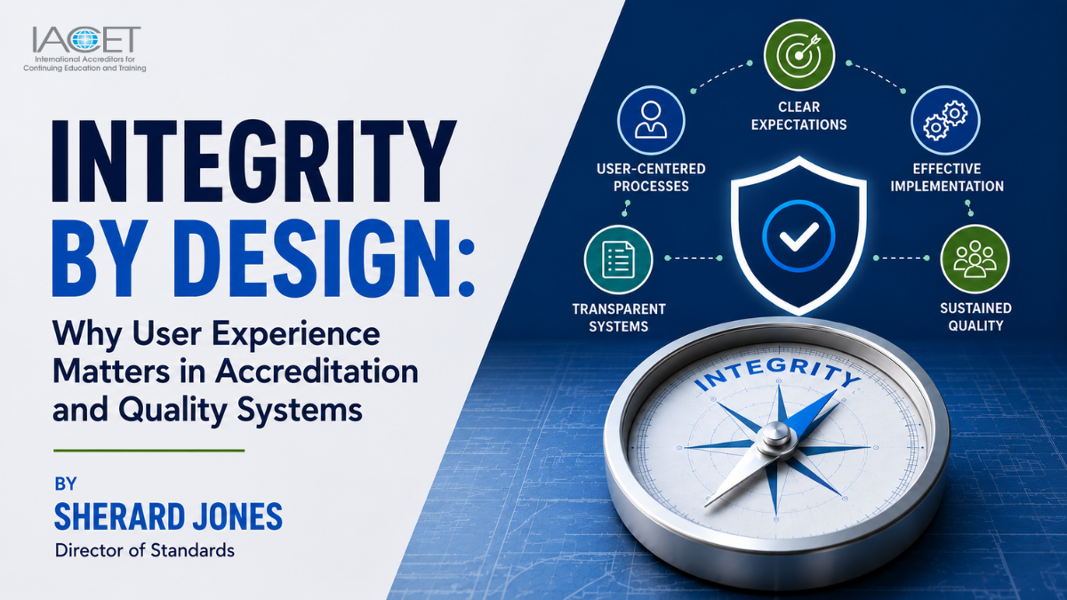
When conversations about integrity arise within accreditation, credentialing, or standards-based environments, they often focus on oversight mechanisms. Audits, compliance reviews, corrective actions, and enforcement processes tend to dominate the discussion. While these tools play an important role, they may not address the underlying challenge organizations face every day.
What if many integrity issues are not the result of deliberate misconduct, but rather the result of systems that fail to clearly communicate expectations? This distinction matters because it shifts the conversation from enforcement to design.
In many cases, organizations are not struggling because they lack commitment to quality. They are struggling because processes are unclear, requirements are difficult to navigate, or expectations are not sufficiently connected to the people responsible for implementing them. Viewed through this lens, integrity becomes more than an organizational value. It becomes a design consideration.
What Causes Breakdowns in Quality Systems?
User experience (UX) is often associated with technology platforms, websites, and digital applications. At its core, however, UX is simply the study of how people interact with systems. Every policy, procedure, accreditation process, and quality framework creates a user experience. The question is whether that experience supports success or unintentionally creates barriers.
Organizations frequently invest significant effort developing standards and requirements. Yet the effectiveness of those requirements is often determined by how clearly they can be understood and implemented by the people responsible for carrying them out.
A well-designed system creates clarity. A poorly designed system creates confusion, and confusion can become one of the greatest threats to integrity.
Most organizations are not looking for shortcuts. They are trying to navigate increasingly complex environments while balancing operational realities, stakeholder expectations, and quality objectives. When systems become difficult to understand or execute, inconsistency can emerge even when intentions remain aligned with the standard’s goals.
Understanding this distinction is important because it shifts our attention toward the experience created by the system itself.
How Should Standards Support Organizations?
One of the strengths of the ANSI/IACET Standard for Continuing Education and Training is that it focuses on outcomes rather than prescribing a single path to compliance. This distinction is important.
The Standard establishes expectations for quality while allowing organizations the flexibility to implement those expectations within their own operational environments. For example:
- Category 5 requires learning outcomes that are measurable and meaningful.
- Category 6 emphasizes alignment between instructional content and intended outcomes.
- Category 8 focuses on ensuring that CEUs are awarded only to learners who have met participation requirements.
In each case, the Standard identifies what must be achieved without unnecessarily restricting how organizations achieve it. This approach reflects an important principle of effective system design: establish clear expectations while preserving flexibility for diverse contexts.
Effective standards help organizations avoid problems before they occur. They provide a framework that guides decision-making, encourages consistency, and creates transparency around what quality looks like in practice.
Equally important is reducing unnecessary complexity. Complexity is often mistaken for rigor, yet excessive complexity can create opportunities for misunderstanding and error. The goal is not to make standards easier; the goal is to make expectations clearer.
Another critical component is helping stakeholders understand the purpose behind requirements. A needs analysis is not simply a procedural requirement; it helps ensure that learning addresses a legitimate performance or knowledge gap. Learning outcomes are not administrative documentation; they provide direction for instructional design and assessment. When organizations understand why requirements exist, compliance becomes a meaningful activity rather than a transactional exercise.
What Does Integrity Look Like in Practice?
Integrity within accreditation is often described as an organizational commitment to quality, accountability, and ethical conduct. While all of those elements are important, integrity also manifests through day-to-day decisions and interactions with systems.
Organizations demonstrate integrity when learning activities align with identified needs, assessments accurately measure achievement, and policies are applied consistently across learners and programs. These actions are influenced not only by organizational culture but also by the systems supporting them.
High-performing quality systems recognize that trust and accountability are not opposing forces. Organizations should be trusted to exercise professional judgment while simultaneously operating within structures that support consistency and transparency.
Too little structure creates uncertainty, while too much structure can limit innovation and responsiveness. Effective accreditation systems seek to balance both, providing enough guidance to support quality while preserving flexibility for organizations operating in diverse environments.
In this way, integrity becomes less about monitoring behavior and more about creating conditions that support sound decision-making.
Why Does This Matter for the Broader Ecosystem?
As continuing education, credentialing, and workforce development systems become increasingly interconnected, organizations must think beyond compliance alone. The challenge is not simply establishing standards. The challenge is creating environments where those standards can be understood, implemented, and sustained across a diverse community of stakeholders.
Policies shape behavior. Processes influence decision-making. Frameworks establish expectations. Collectively, these elements contribute to the culture of quality that organizations experience every day.
When systems are designed thoughtfully, they promote transparency, consistency, and trust. When they are not, even well-intentioned organizations may struggle to navigate expectations effectively. This is why user experience deserves a place in conversations about accreditation and quality assurance.
Integrity is strengthened when people know what is expected, understand why it matters, and have systems that support their success. Organizations that recognize this connection are better positioned to build trust, demonstrate quality, and contribute to a stronger learning ecosystem for everyone involved.
About the Author

Sherard Jones is the President of Strategic Futurist Consulting, an organization whose mission is to provide global leadership in Credentialing, Accreditation and Standards Development. Sherard has over 15 years of experience with IACET Accreditation in various roles and is committed to applying his expertise to support IACET in meeting its strategic goals. Sherard is currently a Lead Assessor for the ANSI-CAP program, has worked as Vice President of Education and Training for IAPMO, and was a past Chair of the IACET Commission. Sherard has 10+ years of experience in strategic program development and has partnered with clients having business needs varying from creating international workforce development programs to build capacity through training and credentialing -- to creating and overseeing organizational restructuring plans.